
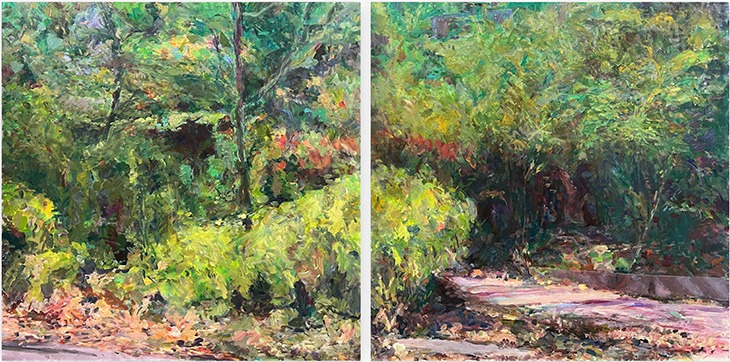
Foad Satterfield, “Hillegass Diptych,” acrylic on canvas, 48 x 96”. All images courtesy of Studio Shop Gallery, Burlingame.
Continuing through August 31, 2026
As human activity relentlessly encroaches on once wild spaces, our relationship to nature becomes increasingly fraught. Where human beings once pitted their fragile bodies against the vast and awesome powers of the wilderness, the tables have clearly turned in our favor, but perhaps not for the best. If we don’t soon destroy the planet with our rapacious and ill-conceived actions, it won’t be for lack of trying. Thankfully, unspoiled areas, and a diversity of open spaces remain, still offering refuge. Ever since prehistoric men and women traced wooly mammoths on cave walls with a stick, artists have sensed the energetic presence of nature and sought to understand our place in it.
“The Shape of Nature” is a contemporary take by three artists on this primordial response as inspired by nature. Foad Satterfield’s paintings use meditative landscapes to investigate abstract concerns; Federico Uribe creates playful, engaging animal sculptures from recycled materials; and Kristine Taylor uses traditional bronze casting to create elegant interpretations of jungle animals and raptors.
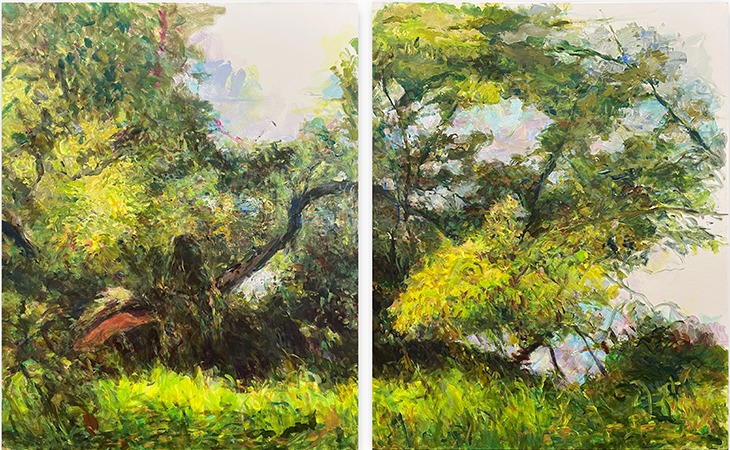
Foad Satterfield, “Slow Practice — Ode to Sonny,” acrylic on canvas, 60 x 96”.
Satterfield’s “Slow Practice — Ode to Sonny” (2026) is dedicated to the late saxophonist Sonny Rollins. At five by eight feet, the diptych encompasses our entire field of vision. What initially presents as a sun-dappled thicket of grass, trees, and bushes quickly dissolves into insistent, rhythmic passages of paint. We sense the energy of the artist at work, our eye tracing the path of his brush, the delicate dance of action and pause, the breath taken between strokes unseen but intuitively felt. Like the jazz musician of the title, the artist works improvisationally to his own internal beat.
In “Hillegass Diptych” (2026) Satterfield captures the foliage of the Bay Area in shades of chartreuse, viridian, and teal shifting into blue-violet, or reversing course into yellow oranges and on to dusky reds. Our journey through this canvas is twofold. On the one hand, it’s a verdant, inviting scene suggestive of a park on a temperate day with a shady path heading into cool recesses. Yet there is something unsettling, the bucolic path shifting to appear slightly ominous, the leaves and branches ephemeral, flickering into shifting planes of color. Channeling the sensuous color of Monet and Renoir, Satterfield also displays a Cubist-style compositional sensibility and the gestural instincts of an action painter. The painter’s eclectic style captures something of his formidable life experience as a Black child navigating the Jim Crow South of Lake Charles, Louisiana. Satterfield found salvation in the creative process, rising through the ranks of the art world and academia highlighted by a 37-year career at Dominican University.
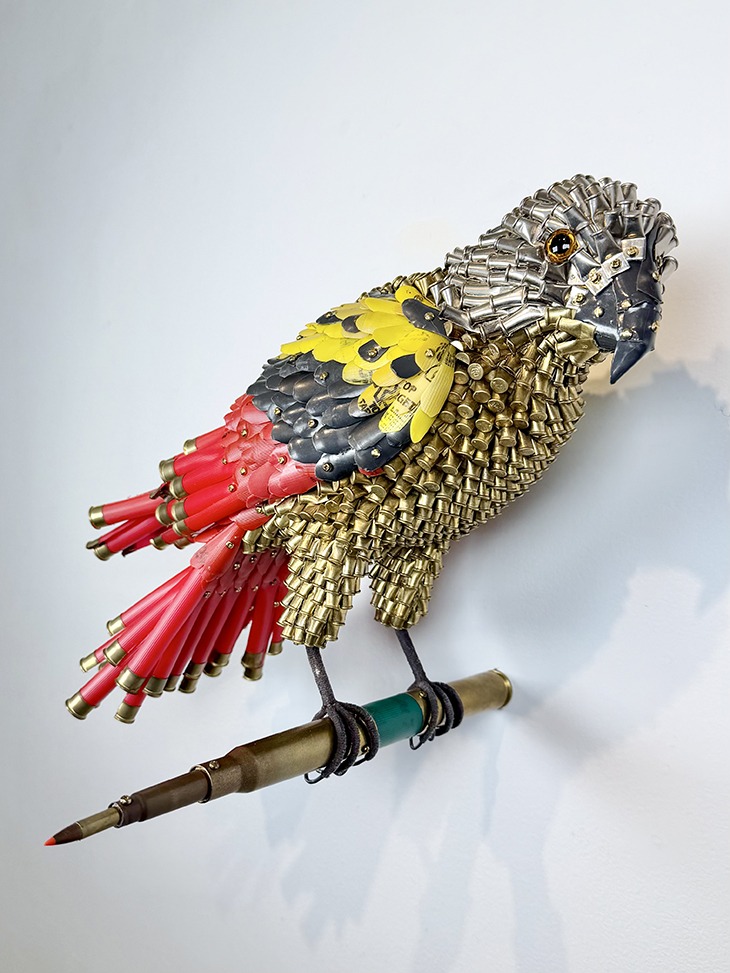
Federico Uribe, “Falcon (Bird 50),” bullet shells, 9 1/2 x 13 x 11”.
Uribe’s small sculptural assemblages are informed by environmental awareness and the sad fact that animals often bear the brunt of natural resource exploitation as their habitats are destroyed. Far from didactic, however, these works are lively and colorful, with an ironic quality. Bright creatures like “Falcon (Bird 50)” (2025), sparkling in red, yellow, and gold, are constructed of colored pencils and/or bullet casings, nails, and barbed wire that recall Bay Area sculptor Al Farrow’s emotionally darker depictions of churches, temples, and mosques likewise created from bullet casings. Says Uribe, “Because nature is screwed, I made a ‘Screwed Panda’.” Based in Miami, the Colombian native also creates life-sized elephant heads. The spiky feathers and fur of Uribe’s menagerie invite us to look, but certainly not to touch. The jutting points of the nails and sharpened pencils stand in vivid contrast to the velvety smooth surfaces of the bronze cats and birds with which they share the gallery.
Taylor returned to fine art after a career in model fabrication and graphic design. She now works with a foundry in Berkeley to create her expressive bronzes of wildlife. “Black Panther” (2026) is a showstopper, its almost life-sized feline conveying an uncanny sense of life, the viewer anticipating it could spring into action at any moment. The cat, a dark brownish black, lounges on a patinated bronze log, with legs and tail draping down to form a tripod supporting the work.
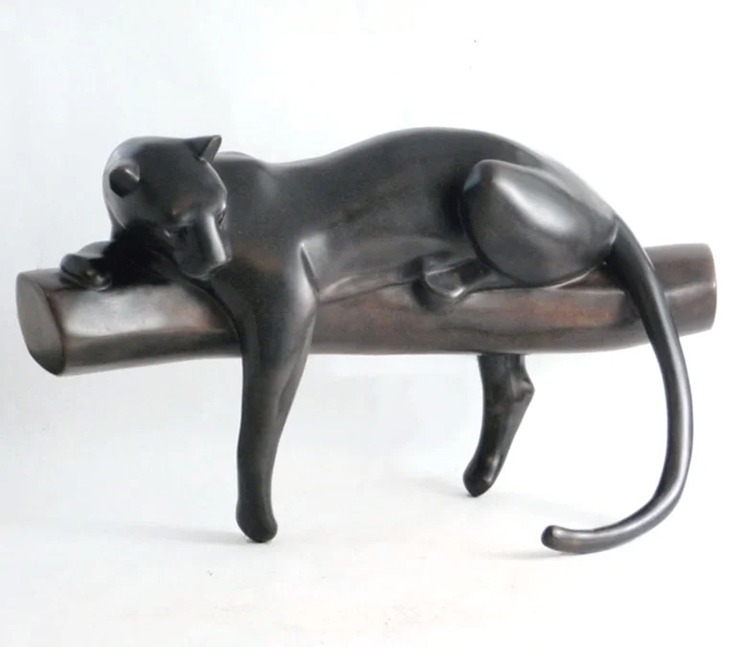
Kristine Taylor, “Black Panther,” bronze, 30 x 56 x 26”.
Taylor’s forms are simplified and edges smoothed, recalling the elegant and engaging work of Beniamino Bufano, the well-known mid-20th century sculptor whose work is widely found in the Bay Area. Taylor’s exhaustive study of an animal’s behavior and appearance enable her ability to infuse the subject with a sense of vitality. Her sculptures also evoke a timeless quality linked to classical antiquities.
Nature indeed comes in many shapes and sizes, not only the grand and the spectacular. If Yosemite Falls or the Grand Canyon inspire awe, we may encounter the wonders of nature in humble surroundings as well. The three artists of “The Shape of Nature” convey amazement in the face of these forces, whether majestic or intimate, even in an age of digital distraction and attenuated attention spans. All that is required from us is a willingness to be fully present and see slowly and deeply, much like those first artists working with sticks on cave walls.


